
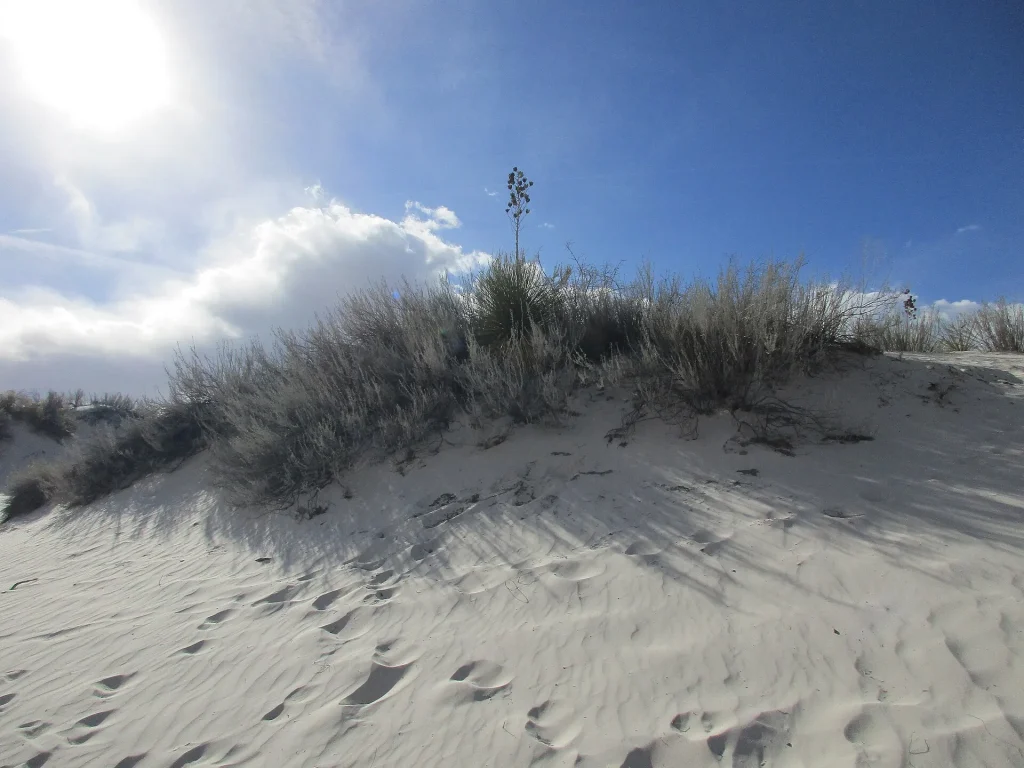
Some discoveries change a date. Others change a story. The fossil footprints at White Sands in New Mexico did the first when they were dated to the height of the last ice age, and new research in Science Advances is now doing the second, by showing that the world around those footprints was anything but stable.
The study (DOI 10.1126/sciadv.aeh0707) reconstructs the environment of the Tularosa Basin during the Last Glacial Maximum, when a large lake, known to geologists as Lake Otero, filled much of the basin floor. Sediment evidence indicates the lake and its surrounding plant life changed repeatedly, in step with abrupt shifts in the regional climate.
Walking a Moving Shoreline
The White Sands trackways capture ordinary moments: people walking, children in tow, a hunter apparently following a giant ground sloth. But if the shoreline itself kept moving as lake levels rose and fell, then the communities using the basin had to keep relearning their own neighbourhood, where the water was, where game gathered, and where edible plants could be found after each shift.
That is a demanding way to live, and the archaeological record suggests people managed it for a long time. Rather than a single brief visit, the footprint layers and the environmental record together point to repeated use of the basin across generations.
Resilience as a Way of Life
The authors frame the findings as evidence of resilience: not grand technology, but knowledge, mobility and flexibility. Small groups survived an unstable ice-age environment by paying close attention to it. Readers can explore the study itself at Science Advances.
It is a theme that echoes through much modern research reporting, including our recent piece on how Students Do Better Without Phones in Class, 16,000-Person Study Says — in both cases, outcomes turn out to depend heavily on the environment people find themselves in.
Why Scientists Keep Returning to White Sands
The Details That Make It Human
Among the most discussed White Sands trackways is one in which a person’s footprints are joined, part of the way, by the smaller prints of a child who was apparently carried for a stretch and then set down. Details like that do not appear in climate graphs, but combined with the new environmental record they create an unusually complete picture: real families, moving through real weather, solving real problems.
Scientists are careful not to over-interpret single trackways, yet the accumulation of evidence is powerful. Hundreds of footprints, animal tracks and now a dated record of environmental swings together describe a lived landscape rather than a fossil curiosity, and that is why each new White Sands paper attracts attention far beyond archaeology.
The human detail in the White Sands record extends to its animals. Trackways show mammoths circling, sloths evading, and at least one sequence in which human prints step directly inside the prints of a much earlier walker, as if following a path on purpose. Layered over the new climate timeline, these moments suggest a busy, shared landscape in which people and animals were all responding, week by week and century by century, to the same shifting water and weather.
There is also a lesson in scientific humility here. A decade ago, few researchers would have predicted that the most eloquent evidence for early American life would come from footprints in gypsum mud, or that lake mud could narrate the weather those walkers endured. Fields advance when new kinds of evidence appear, and White Sands is a standing reminder to keep looking in places older methods overlooked.
Few sites preserve behaviour as directly as White Sands, where a footprint is, quite literally, a moment of a life. The new climate reconstruction gives those moments a setting: an ice-age basin of shifting water and weather, inhabited by people who adapted to change as a normal condition of life. For researchers studying how humans spread through the Americas, that combination of evidence is close to priceless.
